
As London's festival season becomes a distant memory, one argument it leaves behind remains unsolved. Not whether London should keep hosting festivals. Whether its parks should keep paying for them.
Every summer, the same fight plays out across the city: a park fenced off for weeks of build and strike, a court case, a council caught between event fees and resident anger, between the GLA's growth ambitions and its own parks departments. Brockwell Park has had the loudest version of it. It won't be the last.
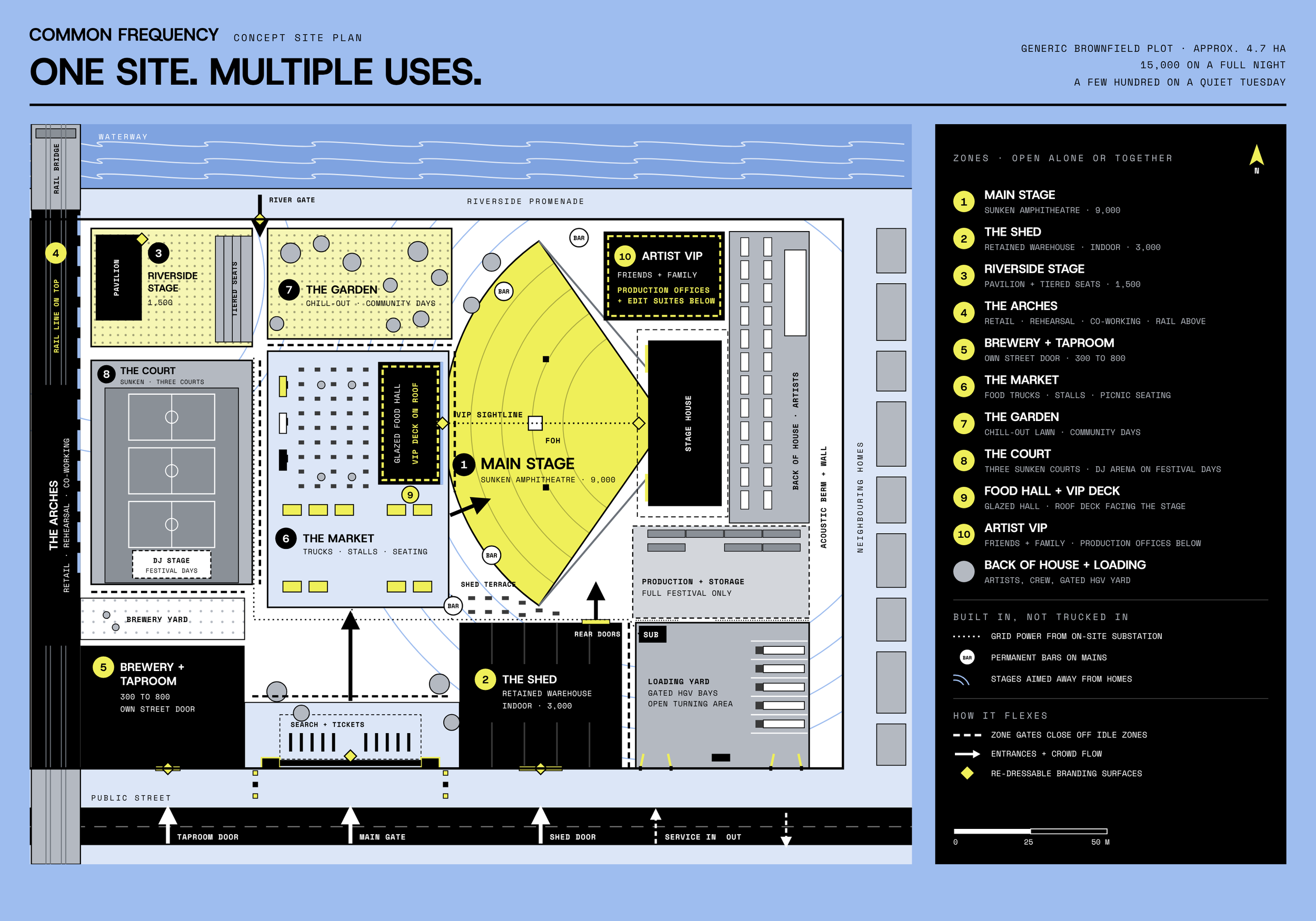
The answer isn't fewer festivals or angrier residents. It's a permanent festival site: purpose-built, reusable, and designed to flex between a 15,000-capacity show and a community event on a quiet Tuesday. London has the land, the demand and the capital appetite to build the first one. Done properly, it stops being London's problem to solve and becomes the UK's blueprint to copy.
Parks were never built for this
Parks are the lungs of big cities. Parks are where people decompress, exercise and socialise, often the only accessible green space for anyone without a garden of their own. Losing that access for weeks at a time, every summer, isn't a scheduling inconvenience. It's a reduction in the one piece of public health infrastructure that costs nothing to use. That trade-off has been treated as negotiable for too long. It shouldn't be.
In May 2025, a High Court judge ruled that Lambeth Council had broken the law by treating Brockwell Park as commercial festival space for weeks at a stretch. A year later, almost nothing had changed: the High Court upheld Lambeth's planning permission for a nine-day event that had drawn 285,000 people the previous summer, after residents and organisers between them spent £200,000 in legal fees arguing about it. Victoria Park, Gunnersbury Park and Clapham Common have all had some version of the same fight.
This isn't bad management. It's a structural problem. Local authorities are incentivised to say yes: event fees help plug maintenance budgets that have been cut for years. A small pool of large promoters captures most of the upside. Community benefit gets negotiated after the backlash, if at all, rather than designed in from the start.
It's also worth being honest about why festivals land in parks at all: rarely because grass makes the show better, usually because a park is the only large, flat, already-serviced open space going spare. That convenience costs real ecology, compacted soil, stripped turf, damaged wildlife, on land meant to be for recovering people, not recovering from them.
On Brixton Buzz, residents describe Brockwell's festivals taking roughly a quarter of the park for about 8% of the year, leaving fenced-off, regrowing turf behind for the rest of the season. One commenter's proposed fix says the quiet part out loud: move the big commercial events somewhere with the infrastructure to take them. Nobody in that conversation is arguing against festivals. They're arguing about where they happen.
The trajectory is visible across two decades of a single festival. Lovebox began on Clapham Common in 2003, drawing 10,000 people, now owned by Live Nation, with tickets past £100 and, this year, a move out of London parks entirely. Banning festivals outright wouldn't fix any of this: demand doesn't disappear when a park says no, it displaces onto whichever green space hasn't organised resistance yet. The problem is the venue model, not the demand.
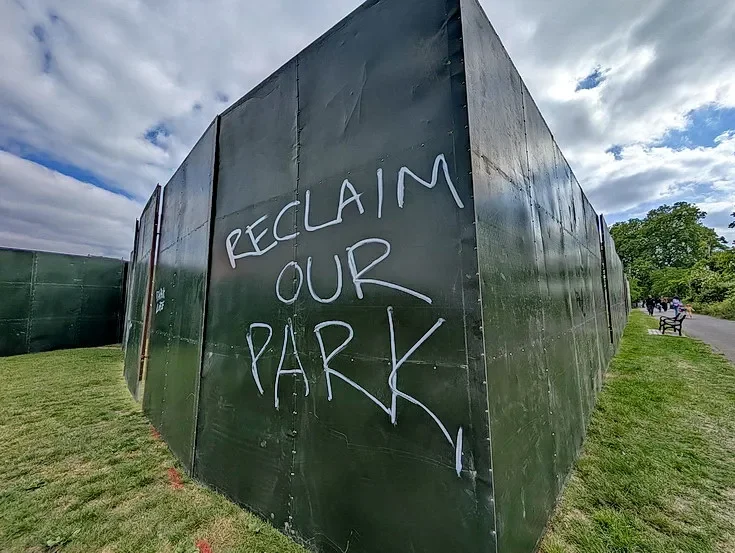
Image: Brixtonbuzz
Build it once, use it all year — every year
The fix isn't a better-behaved booking or a stricter licensing condition. It’s infrastructure: a permanent site where power, water, drainage, access and landscaping stay in place year-round, and programming rotates across them instead of being trucked in and torn down every time a promoter wants a field.
London has tried something like this before, and it's worth remembering why it didn't work. Bloc Festival's 2012 edition opened at the newly built London Pleasure Gardens in the Royal Docks, conceived as permanent cultural infrastructure. It was evacuated on its first night for crowd safety, and the wider site folded within months. The lesson isn't that London shouldn't try again. It's that a one-off, under-capitalised build dressed up as permanent infrastructure isn't the same thing as permanent infrastructure.
The UK already knows the indoor version works. Broadwick Live has converted a former IKEA warehouse into Drumsheds, a 15,000-capacity venue in Tottenham, and a former rail depot into Depot Mayfield in Manchester. Lloyds Banking Group injected £20 million into Broadwick Group in 2025 to expand further: cultural infrastructure is now bankable at institutional scale.
None of this is simple to site, and it's worth being upfront about that. The location has to be well-connected enough to get over 15,000 people there and home again, large enough to run at full capacity, and still far enough from housing that a handful of big outdoor shows each summer don't just recreate the noise complaints a park would have caused anyway. Those three requirements rarely point to the same postcode.
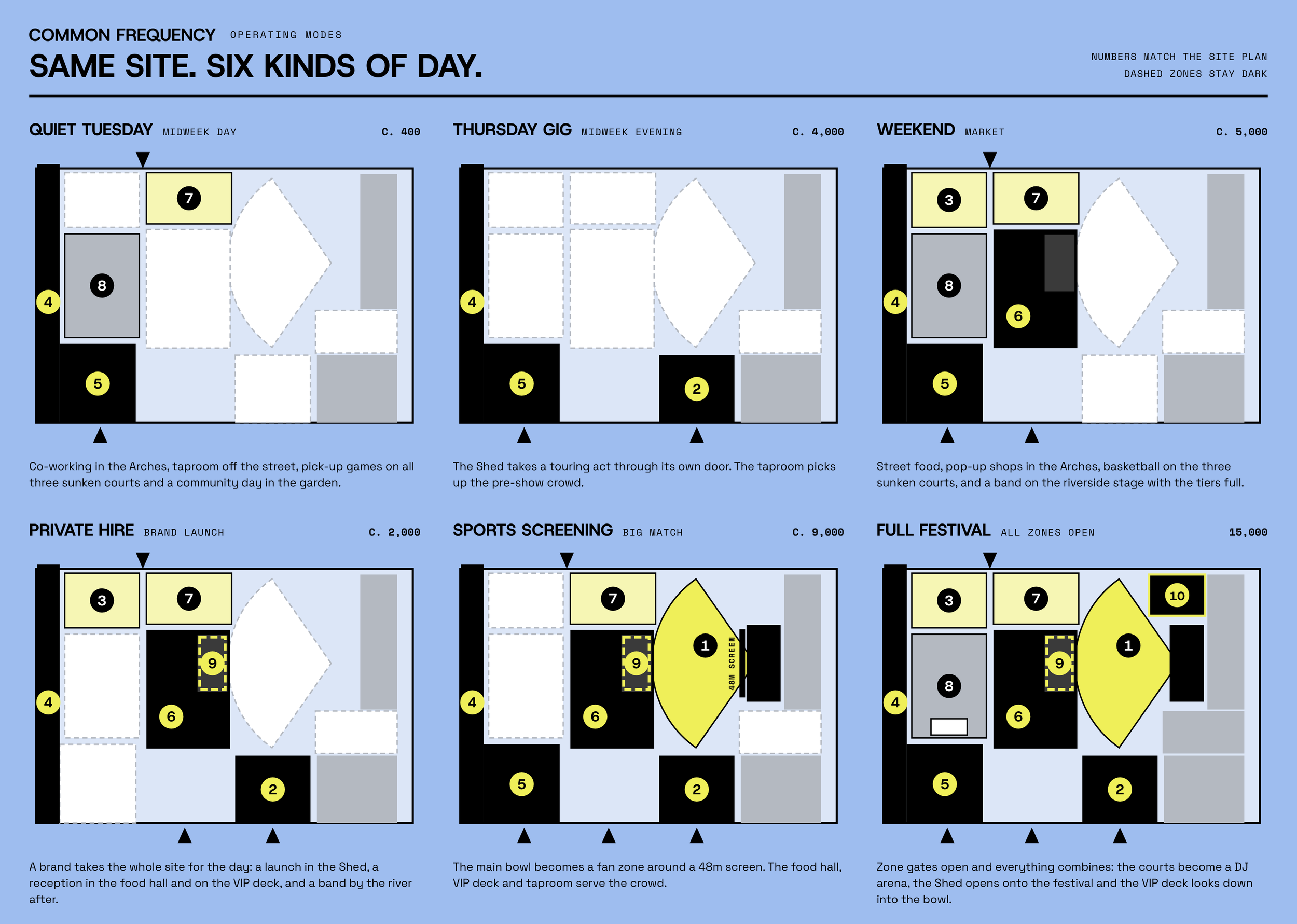
The design principle that matters most isn't scale. It's modularity, and it's the part designers, architects and operators should pay closest attention to. A permanent site doesn't need to run at full festival capacity to earn its keep. Built right, a brewery, a smaller stage, a loading yard that doubles as event space, can open on a quiet weekday for a few hundred people while the rest stays dark, then combine for a 15,000-capacity show the next month. That flexibility is what keeps operating costs down and the calendar full: something a stage built once a year in a field can never offer.
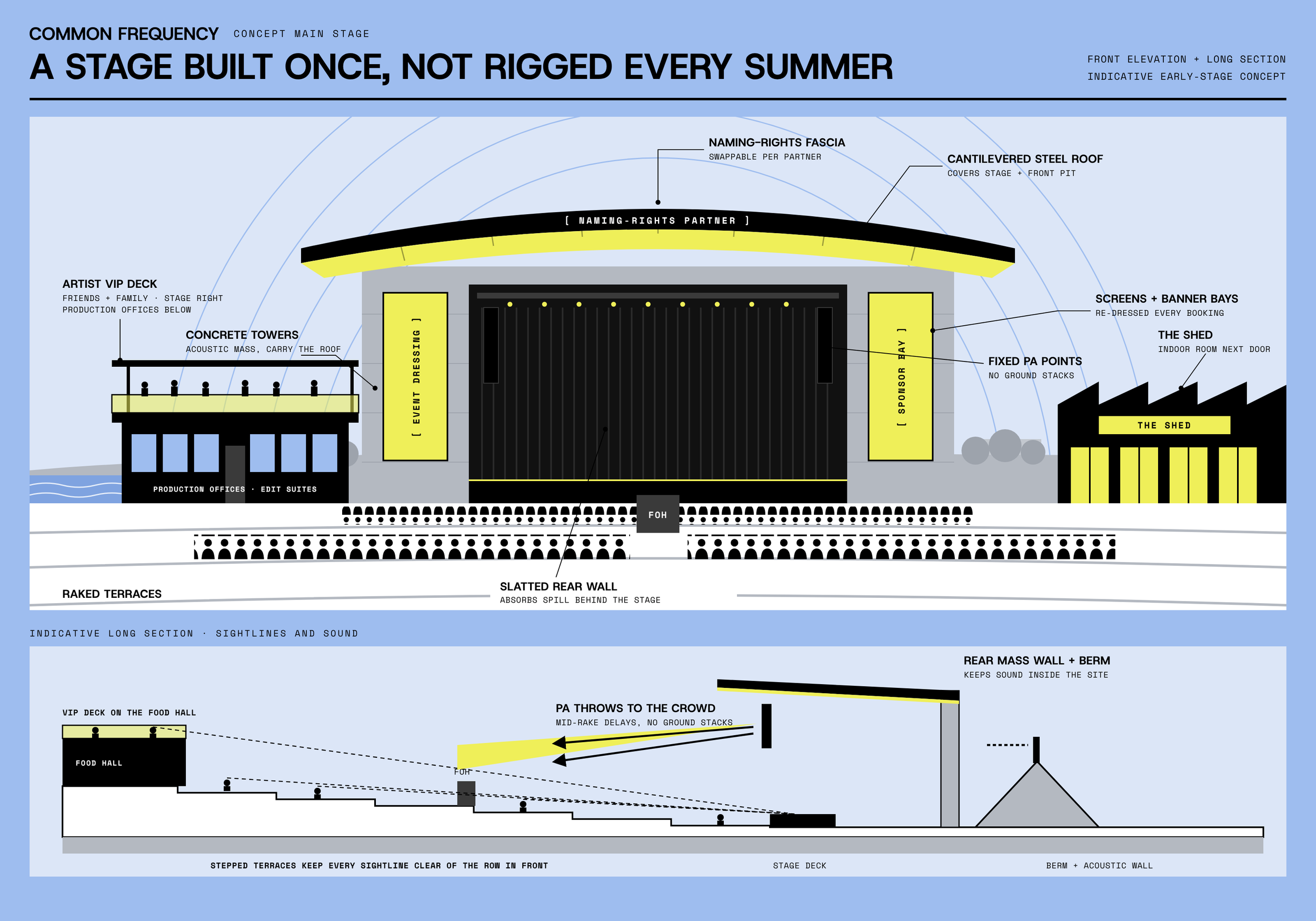
That modularity extends to branding, too. The stage, the bars, the entrance, even individual zones, can be dressed and rebranded for each event, which means naming rights and sponsorship deals can be built into the site itself rather than bolted onto a one-off festival logo.
The core logic is capex once versus opex every time. A park festival rebuilds a temporary city from zero for every event and writes off that capital at strike. A permanent site capitalises its infrastructure once and depreciates it across years, multiple operators and events: the kind of asset investors and public bodies alike can actually underwrite.
| Park model | Permanent site | |
|---|---|---|
| Power | Diesel generators, trucked in and out every time | Fixed grid connection — quieter, cleaner, cheaper per event |
| Food & drink | Temporary catering units, one-off suppliers | Permanent, high-quality F&B, potentially an on-site brewery, cutting transport |
| Noise | Managed per event; residential edges unavoidable | Acoustically planned from the start |
| Public land | Closed for weeks of build/strike for a few days of show | No public land taken out of use at all |
| Promoter access | A weekend booking, sharing a public space's constraints | Full-site takeover, arena-style creative control |
| Calendar | One booking at a time, capped by what a park can bear | Year-round — community events through 15,000-capacity shows |
| Capital | Spent once and discarded at strike | A one-time investment that compounds in value every year it operates |
The concept site
Other cities are looking at this.
Barcelona didn't set out to build a festival site. It inherited one. Parc del Fòrum was designed for a marine zoo that collapsed with Spain's financial crisis, leaving a vast seafront esplanade with nowhere to go. Primavera Sound moved in in 2005; Sónar followed. Combined capacity has run as high as 95,000, permanently sited, in a major European capital that never has to fence off a park to host it.
Three more recent examples make the same case from a different angle: permanence that takes pressure off public land, rather than borrowing it for a weekend. Ascend Amphitheater opened in 2015 inside Nashville's Metro Riverfront Park, on derelict land the city had sat on for over a decade. At 6,800 capacity, it stays in public ownership and hosts everything from stadium tours to a free Community Day, on the same site, without the park ever being fenced off between bookings.
The Salt Shed opened in Chicago in 2022, inside a former Morton Salt plant, running two separately programmed spaces, a 5,000-capacity outdoor stage and a 3,600-capacity indoor room, that can operate apart or together. Grind City Amp opened on the Memphis riverfront this April, built in front of an existing brewery it shares a ticketing system with: the newest and smallest of the three, but the same underlying model. Build the big room once, and let smaller, cheaper programming keep it alive between the big nights.
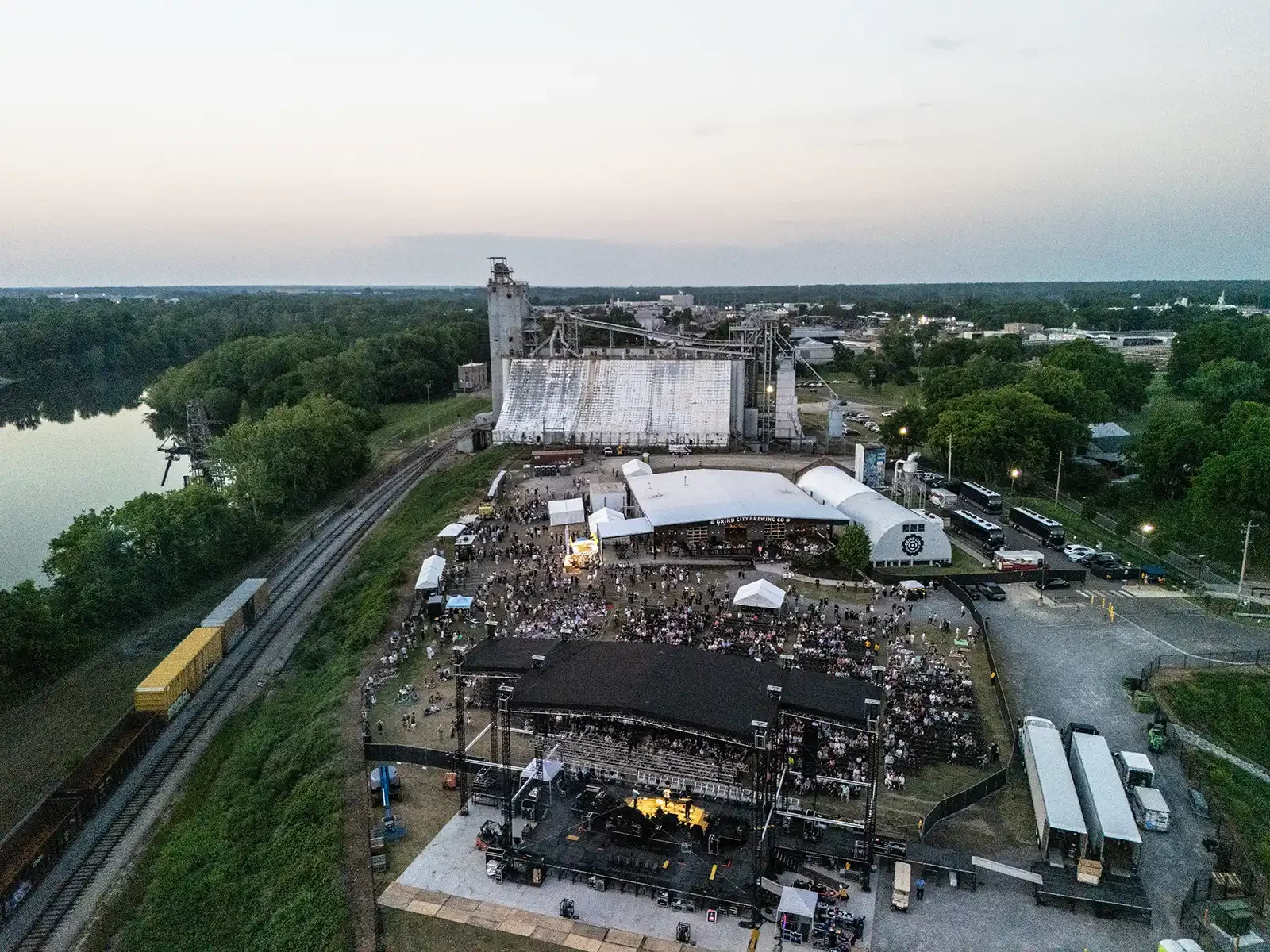
Image: Grind City Amp
Keep the demand. Lose the fight
The market this sits inside is sizable, growing, and still structurally fragile, and that combination is the real investment case: demand keeps climbing even as the supply of places to put it keeps shrinking. The Association of Independent Festivals counted 592 music festivals running across the UK in 2025, but 250 more closed between 2019 and mid-2025, proof that none of them survive on demand alone when every one has to rebuild itself from scratch. UK music tourism hit a record £11.2 billion in 2025, from 24.7 million music tourists, up almost 27% year on year, and London alone accounted for £3.4 billion of that from 9.1 million visitors, also up 27% on 2024. Brockwell Live's own 140,000 attendees this summer are folded into that London number, which is exactly the problem: the same festival the city's economy depends on is also the one fighting a court case over whether it's allowed to happen at all. A permanent site is the only way to keep the demand and lose the fight.
The same site doesn't have to sit idle between music bookings, either. A space built to flex between a major show and a quiet weekday can host trade exhibitions, sporting fixtures and community events through the parts of the calendar touring acts don't fill. It can just as easily open as the biggest screen in the city for the sport it can't host live — a World Cup final, Wimbledon's finals weekend — pulling in a crowd no pub garden could hold. More bookable days against the same fixed capital cost does most of the work on its own.
There's a public-interest dividend too. Deliberately programmed slots for emerging UK talent turn the site into a pipeline, not just a big-show venue, at a moment when 175 UK towns and cities no longer receive regular professional touring shows. For the GLA and local authorities, that's a venue that funds its own upkeep and takes pressure off parks departments, rather than one more thing competing with them for the same land.
None of this argues for banning festivals from parks outright; the very largest, 40,000-plus crowds, will probably still land on grass some years. What changes is the baseline: a permanent site gives mid-scale bookings somewhere else to go, freeing a park's calendar for the community and green use it was built for. Sited on brownfield or derelict land rather than parkland, that relief costs the city none of the green space it's trying to spare: it's additional capacity, not a trade.
If you build it, they will come
The fight over which park gets the next festival isn't really a fight about festivals. It's a fight about who public land is for, and Brockwell won't be the last time a court has to settle it.
London has already proven that large indoor versions work. The international examples make the same case for the outdoor, flexible-capacity version: permanence works, and it takes the pressure off public land rather than borrowing it for a weekend. London has the land, the policy appetite for meanwhile use, and a cautionary example, in Bloc Festival and the London Pleasure Gardens, of what happens when ambition outruns capital.
There's a regional dimension worth naming plainly, too. Cardiff, Belfast and Sunderland are each pushing to take the title of the UK's leading music city off Manchester and Liverpool. A permanent festival site doesn't have to be London's to claim first, and whichever city builds one gets to make a statement no single booking announcement can match. London has the land, the demand and the capital already circling it.
