
Daegu's KRW500bn dome bid is a test of how Korea fixes its venue gap
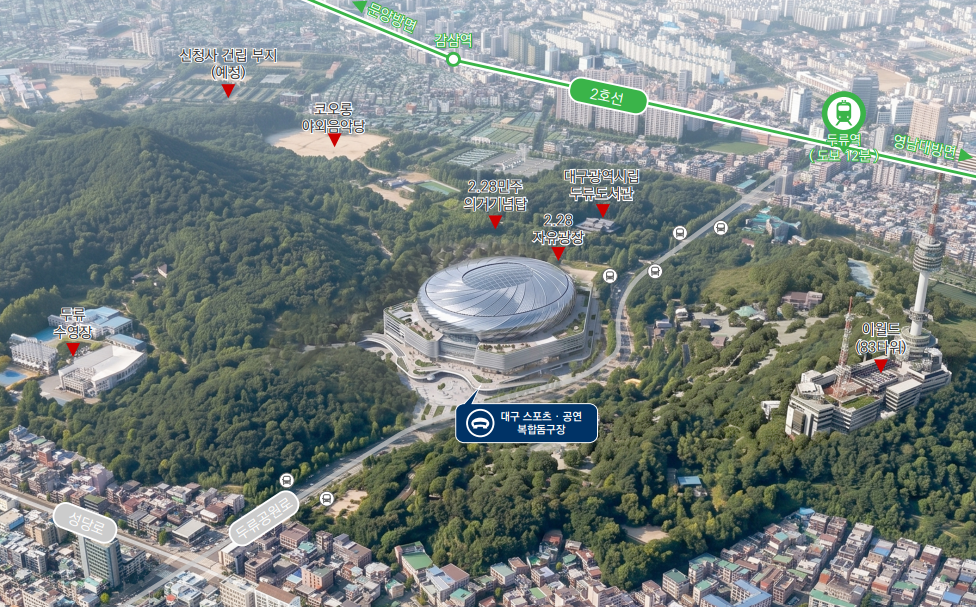
Image: Daegu City
Daegu has put a number on its ambition. The city has set out plans for a "Dome Stadium" of 20,000 seats, expandable to 28,000, at an estimated KRW500 billion (about $366m).
The brief is year-round: international and domestic concerts, basketball, esports, badminton and indoor tournaments. Mayor Choo Kyung-ho called it a chance to "overcome local sports limitations and inject new vitality into the local economy".
In August, the Ministry of Culture, Sports and Tourism told President Lee Jae Myung it wants multipurpose domed stadiums built for both sport and K-pop. On 21 September it briefed local governments on how that will work: a competition for one large-scale and one mid-scale dome, each part-funded by the state.
Bidding opens mid-October, proposals are due early December, and winners are to be chosen before the end of the year. Daegu won't be alone. Busan has confirmed it's bidding, and South Chungcheong, Sejong and North Jeolla have all shown interest.
Korea's live-music boom has outgrown its buildings. Seoul's biggest stages are sports grounds first: Jamsil's Olympic Stadium has been out for renovation, and Seoul World Cup Stadium's pitch and acoustics make it a compromise. Promoters have drifted to Goyang's open-air stadium and Incheon's 15,000-capacity Inspire Arena, while Seoul's own purpose-built K-pop arena in Chang-dong isn't due until 2027.
Outside the capital, it's thinner still. Daegu's main indoor venue, the Daegu Gymnasium, opened in 1971 and holds 3,800. For big tours, a city of roughly 2.4 million simply isn't on the map.
Daegu previously looked at a 50,000-seat dome and walked away. Building it would have cost more than KRW1.2 trillion, and running it looked hard to justify. That's a candid call.
It also sits awkwardly with the national brief which aims for 50,000 seats for a large dome and 30,000 for a mid-scale one. At 20,000 to 28,000, Daegu is pitching under both. Either the criteria flex, or the plan grows before December.
The money follows a familiar model: state funding and private capital, with the city's own outlay kept to a minimum. The lever is planning. Daegu would relax building coverage and floor-area limits so a partner can add hotels, retail and convention space around the dome.
If Daegu is selected, feasibility and deregulation work starts straight away. Detailed design follows in 2029, with construction from 2031.
This is what closing a venue gap actually looks like. The demand is proven. Policy is moving. The capital stack is public land, a state grant and a density bonus to bring in private money.
The open questions are routing and operations. Can a 20,000-seat room in Daegu hold a tour that's already playing Seoul and Busan? And will a private partner believe the surrounding development pays? Operating risk is what killed the bigger version. We'll know by December whether Daegu makes the shortlist.
