
The Fandom Effect: Can stadiums become the new town square?
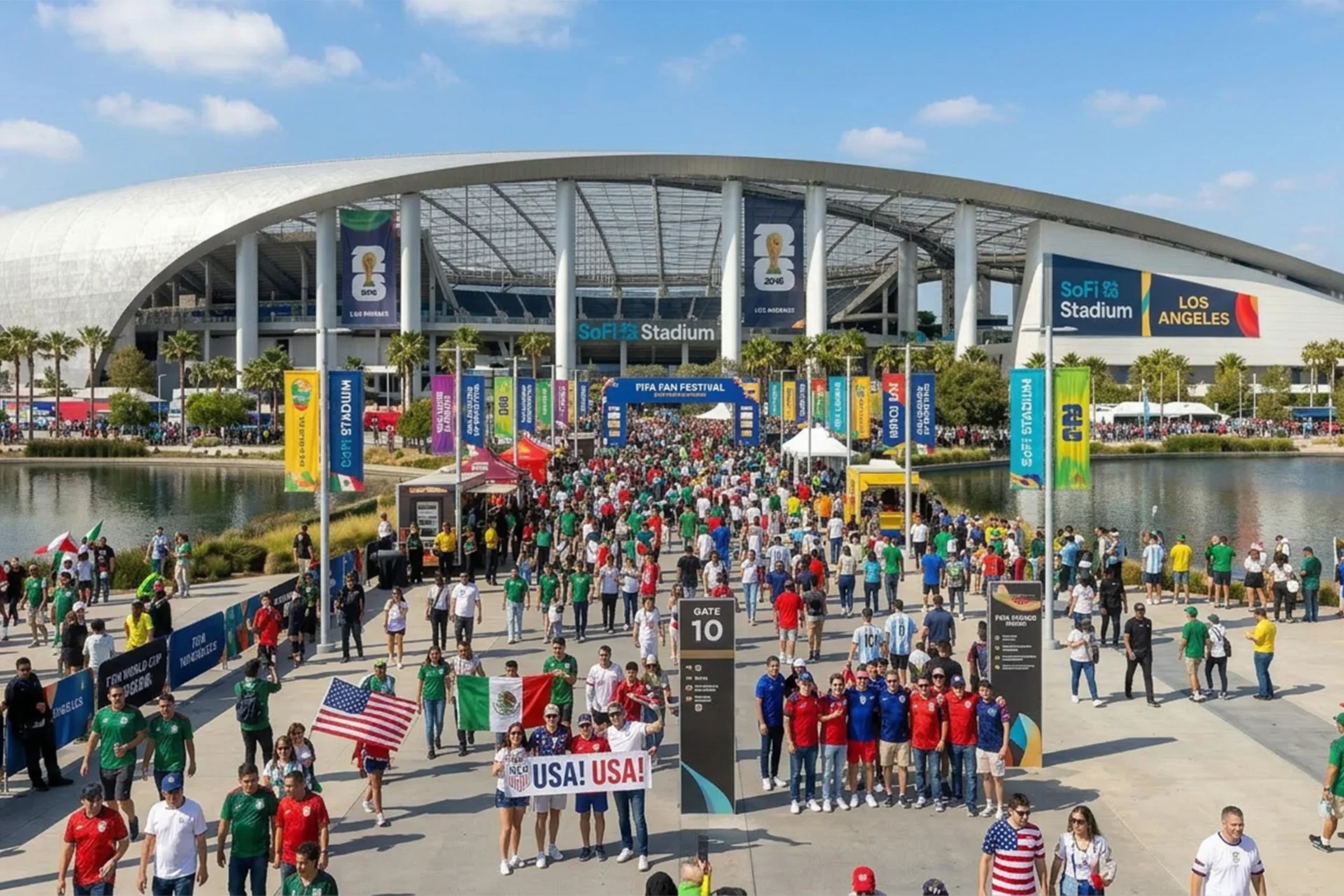
SoFi Stadium, LA during the World Cup 2026
Gensler Research Institute study of the FIFA World Cup 2026 asks whether stadiums can become the new town square
The Fandom Effect: Sports Urbanism 2026, a new study from the Gensler Research Institute, ROAR, and Oxford Economics, asks whether stadiums and their surrounding districts can become the new town square. It lands as sports-anchored mixed-use districts (SMDs) are expected to attract more than $100 billion in investment globally over the next 15 years, with 37 North American teams announcing SMD plans in the last two years.
Lauren Adams, Global Director of Lifestyle Research at Gensler, said the space around the stadium is where fans feel they become part of something, and that it should be designed “with the same intentionality as the bowl”.
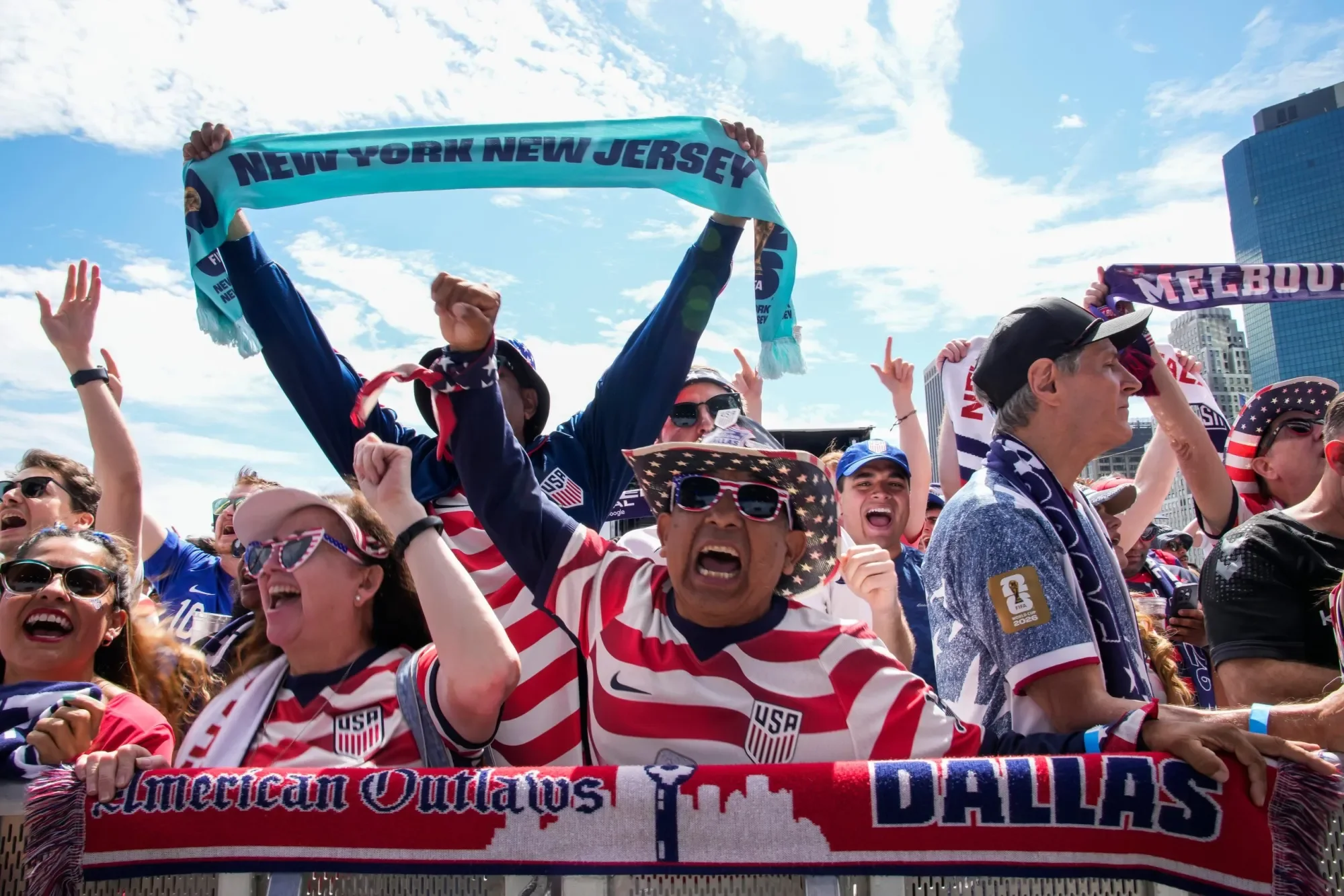
Fans celebrate during the announcement of the United States men’s national soccer team roster May 26, 2026, in New York, ahead of the FIFA World Cup soccer tournament. (Eduardo Munoz Alvarez | AP archives)
Venue design drives the afterglow
ROAR’s analysis tracked “afterglow”, the extended celebration that follows a match. Venues wrapped in a mixed-use, fully activated districts generated roughly 50% more post-match celebration, regardless of weather, walkability, match popularity or score. Isolated stadiums ringed with parking emptied out fast, sometimes in under two hours.
Where there was no gathering space next to the stadium, celebrations moved to downtown landmarks miles away, such as Times Square in New York and the Power & Light District in Kansas City. These existing destinations outperformed the fan zones designated by FIFA. New York/New Jersey recorded the highest total afterglow score of the 16 host cities, while Toronto recorded the lowest.
Friction starts before fans reach their seats
Arrival, entry and ticketing were the only consistently negative themes in the social listening study, with 19% of posts on the topic negative or critical, compared with 5% for the bowl, seating and sightlines. It was also the one stage of the fan journey where language associated with awe was almost entirely absent. Once inside, 80% of match attendees said it was easy to view the action from their seats.
The research identifies the entry sequence as the lowest-risk, highest-return place to invest in design, both for major events and for everyday use. Adam Grossman, President at ROAR, said tackling traffic and ingress issues, through design and on game day, would allow the positive aspects of attending live sport to resonate more clearly with fans.
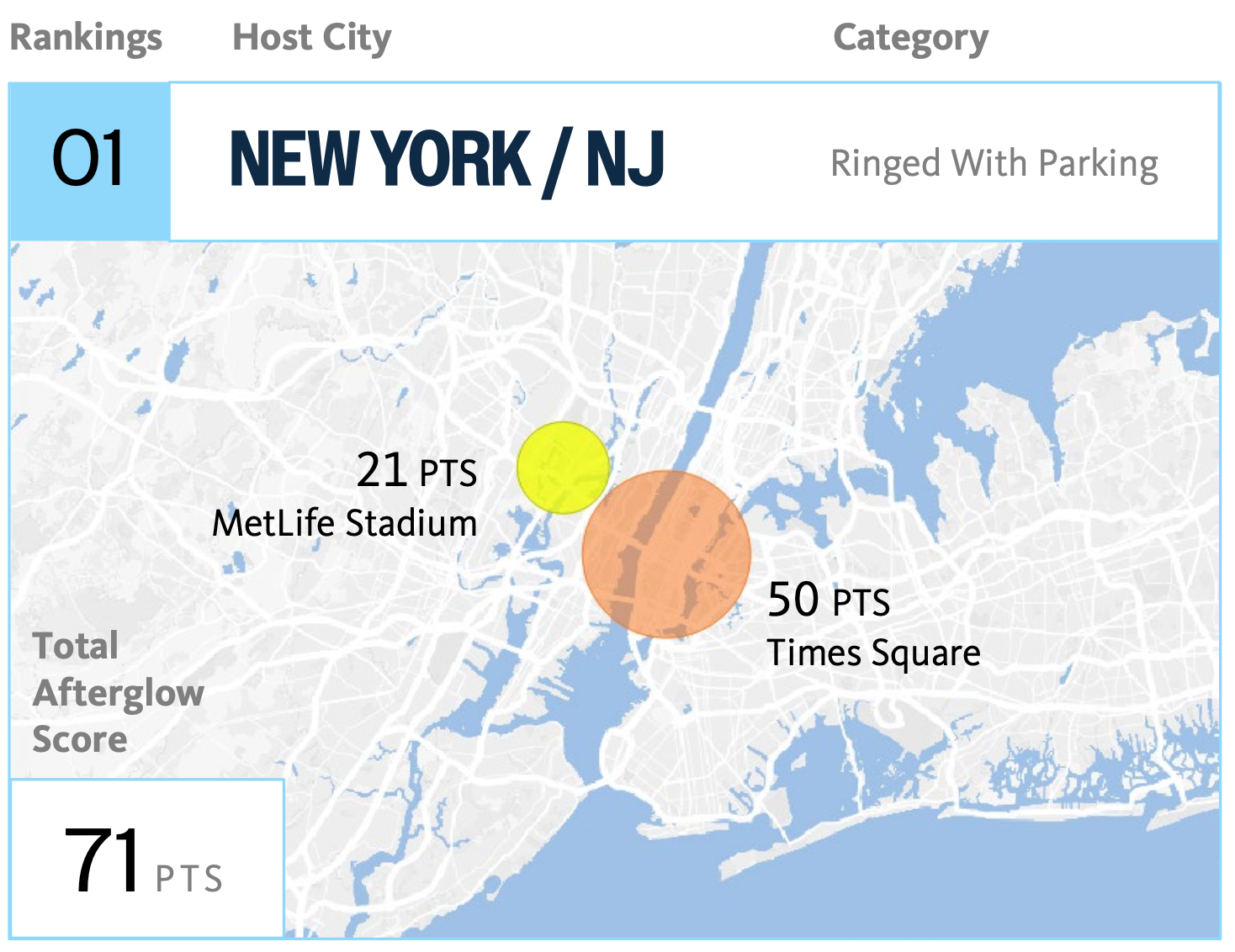
Mapping the Afterglow of the MetLife Stadium, NJ.
The tournament won over host cities
The post-tournament survey found 89% of respondents said the World Cup was good for their city’s image, and 71% described their host-city experience during the tournament positively, with few finding it stressful or disruptive. Among match attendees, 88% said the experience was worth the money despite high ticket prices, and 71% attended more than one match.
Belonging was a key driver: wanting to be part of the atmosphere was the top reason for attending, and 84% of attendees also watched matches in a public group setting. Some 63% of all respondents said they were more interested in attending major events in the future, rising to 72% among Gen Z, with that interest extending to concerts, cultural festivals and food events as well as sport.
Outside a global event, districts fall short
The baseline survey, covering 73 venues, found 87% of recent visitors rated the venue experience positively, compared with 69% for the surrounding district. Some 90% would recommend the venue, against 71% for the district.
Safety and family offerings account for much of that gap. Some 69% ranked safety among the top three qualities of a good sports district, and 57% said nearby family activities would make them more likely to buy a ticket, yet only 39% found such activities around the venue they last visited.
Interest goes well beyond game day. Food festivals (42%), seasonal or holiday events (37%) and farmers markets (34%) topped the list of non-event-day draws. People who live or work near a venue are already the most engaged: 84% seek out events at specific venues because of their attachment to the surrounding area, compared with 56% of non-locals.
Better events start with better cities
Host-city residents drew a clear line between event-day operations and everyday city life. Among those who had a negative experience during the tournament, traffic and congestion (58%) and crowded or unreliable public transit (43%) were the main complaints.
For future events, residents want cities to prioritise traffic management (41%) and safe public areas (39%), followed by clean public spaces and crowd management. Over the long term, they want more reliable public transit (42%), cleaner and better-maintained public spaces (41%), and investment across neighbourhoods rather than only in event areas (38%).
Five steps to a new town square
The report sets out five steps for turning sports districts into year-round civic spaces:
Improve access and perceptions of safety
Deepen the offer for locals
Add low- or no-barrier attractions
Zone the mix of uses by audience
Programme festivals and seasonal shows
Taken together, the findings suggest that the value of a sports district lies as much in the streets and plazas around a venue as in the bowl itself. With more than $100 billion expected to flow into SMDs, the report positions safety, access, everyday use and shared experience as the factors that will determine whether these districts become genuine town squares.
Download the full report: https://www.gensler.com/gri/sports-urbanism-2026
